

Taking Her Advocacy Global: Vicky Represents Australia at International Finals
July 9th, 2026

July 9th, 2026
Future Problem Solving (FPS) is an educational program and academic competition that teaches students creative problem-solving skills, critical thinking, and long-term forecasting – equipping them with lifelong learning skills and teaching them how to think, not what to think.
Through the Community Projects program, students identify an area of concern within a chosen community and apply the FPS process to develop a project proposal.
Currently studying VCE Biology and Psychology, Vicky's long-term project, 'The Eureka Project', centred on the underdiagnosis of ADHD and Autism in girls. Over the past two years, she authored and designed a comprehensive toolkit for parents and teachers and wrote a detailed research paper addressing the gaps in research literature.
For Vicky, this project was deeply personal.
“I was diagnosed late with ADHD. As I spoke to my female friends, I increasingly realised that many of them were also diagnosed late for ADHD: a condition that was more readily recognised and supported in boys,” explains Vicky.
According to the Child Mind Institute, many girls are also overlooked when it comes to being diagnosed with Autism, as they “don’t fit the stereotypes or their symptoms are misinterpreted as something else.”
Vicky found this observation reflected in her own conversations with experts in the field, including Dr Kate Witteveen, Lecturer in The University of Queensland's Faculty of Health, Medicine and Behavioural Sciences.
“As I spoke to experts, I found that a huge reason for this underdiagnosis was because of gendered conceptualisations of what ADHD or Autism should look like, which is oftentimes the male, instead of the female presentation,” Vicky says.
Vicky has shared her important work at various forums throughout the past year, including the Stanford Neurodiversity Summit in September 2025, where she partnered with the Stanford Network for K-12 Neurodiversity Education and Advocacy (NNEA) to help distribute adapted advocacy brochures to clinics across the United States.
She was also invited to be the sole youth speaker at the International Coalition of Girls Schools (ICGS) Symposium, a global gathering of educators and leaders from girls' schools, which was held at MLC in April.
Her selection for the FPS International Finals was a significant milestone, placing her among the top 7% of participants in the competition. The experience also gave Vicky the opportunity to present her findings to her fellow competitors, members of the public, and visiting families.
“This topic is so close to people’s hearts. If not a personal experience, it was one that affected their children or siblings or friends,” says Vicky. “So, I was able to instantly connect with hundreds of strangers, from all walks of life, from different parts of the world.”
Learning Diversity Teacher Kathy Bernardi acknowledged the significance of Vicky’s achievements and the important role these presentation opportunities have played in her success.
“These opportunities made a huge difference to her outreach work, and it was wonderful to see her confidence and presentation skills grow throughout the year,” says Kathy. “Her project was one of a very small number that were selected to attend the International Finals, and the quality of her work was amazing.”
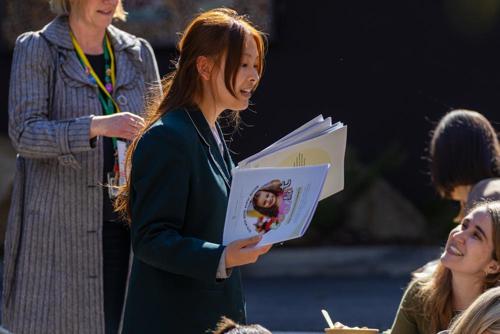
Vicky discussing her toolkit and resources at the ICGS Symposium.